Saturday, June 29, 2013

Vocabolario II (Vocabulary 2)


Well, it turns out that my supplications for an "English-Italian Military Dictionary" were heard; among a boxfull of ephemera won on ebay was an almost pristine copy of Army publication TM 30-603 "Italian Phrase Book' dated September 16, 1943. Unlike a typical tourist phrase book, this one is guaraneed to have some very useful phrases like, "Where is the enemy?" and "Hands up!" So without further adieu...

Useful Phrases:

  • Help me. I am lost. - Aiutami. Sono sperduto.
  • Draw me a map. - Fatemi uno schizzo.
  • Are there soldiers near here? - Ci sono dei soldati vicini?
  • I am wounded. Get a doctor. - Sono ferito. Chiamate un dottore.
  • Where is the enemy? - Dov'è il nemico?

Orders and Warnings:

  • Look out! - Attenzione!
  • Take cover! - Mettetevi a riparo!
  • Quiet! - Silenzio!
  • Stand up! - Alzatevi!
  • Come forward! - Venite avanti!
  • Turn around! - Voltatevi!
  • Stop! - Fermatevi!
  • Who goes there? - Chi va là?
  • Identify yourself! - Fatevi riconoscere!
  • (Give the) Sign! - Parola d'ordine!
  • Countersign! - Contraparola d'ordine!
  • Don't move! - Non muovetevi!
  • Surrender! - Arrendetevi!
  • Throw down your weapons! - Buttate a terra le armi!
  • Hands up! - Mani in alto!
  • Line up! - Mettetevi in fila!
  • Don't try anything! - Niente trucchi!
  • Obey or I'll fire! - Ubbidite o sparo!

There! That should get you through!

Wednesday, June 26, 2013

Omonimi delle Battaglie MoR I (MoR Battle Namesakes 1)

CAMPO DI CARNE

Campo di Carne is a small town on the road between the Anzio beachhead and Aprilia, south of Rome. Its existence can be established as far back as 1661 when it was included on a colorful map of the area. The origins of the name (literally, 'field of meat') are presumed to be rooted in the long-standing use of the area as a place to raise cattle and other animals for eventual human consumption. By mere coincidence, the town's peculiar name would take on additional significance during World War II.

By January 24, 1944, the Allied Forces that had come ashore at Anzio-Nettuno had reached Campo di Carne while German units were massing north of Campoleone. Territorial gains beyond Carroceto and 'The Factory' (Aprilia) extended the line, until the ferocity of Operation Fischfang (=Fishery) forced British 56th Division to retreat to Dead End Road, close to the overpass (a road bridge over the railway) at Campo di Carne from where they had set out three weeks earlier.

The overpass, known as 'The Flyover', was under severe and constant bombardment from heavy artillery in the Alban Hills and was known to men who had to fight there as 'The Gate to Hell'. The nearby railway station still exists but there is no immediate sign of the carnage that took place in 1944. War photographs of the overpass have come to represent the horror of the Anzio beachhead. By most accounts some 30,000 people, civilians included, died during the fighting in this area.

Monday, June 17, 2013

Varie Cose I (Odds and Ends part 1)

La Borsa Tactica (The Tactical Case)

This little 10"x10"x5" oddity has been the source of a lot of confusion and discussion. An Italian surplus dealer described it as a pre-war satchel charge container; someone else said it was a clerk's desk; others insisted that it's a post-war item, but could not say for sure what it was. Given that it's made of tin covered with canvas, I sort of felt that it had some purpose where it would be handy, if not indispensable, to protect whatever was inside from contact with hot stuff falling from the sky. I acquired one online for less than $20; someone sold one in Australia for over $90 and I've seen them for as little as $10.

Turns out it's a Borsa per accessori da mina (Case for demolitions materials), the argument concluded thanks to a printed inventory sheet found inside one example. The items that were normally carried inside include:
  •  n.1 coltello da tasca
  •  n.1 forbicetta mezzana
  •  n.1 pinza tagliastrozza
  •  n.1 gomitolo di spago da mm.2 straforzinato
  •  n.1 gomitolo di spago da mm.0,6
  •  n.50 tubetti di gomma per giunzione miccia
  •  n.1 martello a granchio
  •  Kg. 0,5 punte di filo ferro
  •  Kg.05 cambrette
  •  n.1 rotolo nastro isolante
  •  n.10 clips per giunzone miccia
  •  n.1 tasca per tritolo vuota
  •  n.1 borsetta per miccia vuota
Oh, and the inventory sheet cites a stock number that sources assure me is post-war - doesn't completely establish that these things did not exist before or during the war; doesn't say they did either.

Torcia Rettangolare (Square Flashlight)

I'd never seen one of these before March on Rome III in 2012. They were evidently common (standard issue?) among German soldiers and examples made in other European countries can be found. A major Italian producer of similar units was Vigila Pagani, though some say that they didn't get into making this sort of flashlight until after the war.

The unit typically has one or more colored filters that can be lifted into position via the appropriate slider and leather or vinyl tabs with button holes at the top and bottom for fastening it to shirt or tunic buttons for hands-free operation. These are typically powered by an odd (to Americans) 4.5V rectangular battery that costs $6 to $9 and has to be special ordered.

I've found a source for replacement battery boxes that hold 3 AA batteries. To this, I added a stick-on wrapper laboriously copied from a vintage Italian Superpila battery. I also have artwork for a Wehrmacht-issue  Daimon-brand battery.

Wednesday, May 29, 2013

Inni Partigiani II (Partisan Hymns 2)

Fischia il Vento (The Wind Whistles)

According to Wikipedia, "Fischia il Vento is an Italian popular song whose text was written in September 1943, at the inception of the resistenza. The lyricist was Felice Cascione and the intention was to spur on the partisan movement. The music is that of the Russian popular song Katyusha.


Along with Bella, Ciao! it is one of the most famous songs celebrating the resistance."

Fischia il vento e infuria la bufera,
Scarpe rotte e pur bisogna andar
A conquistare la rossa primavera
Dove sorge il sol dell'avvenir.
A conquistare la rossa primavera
Dove sorge il sol dell'avvenir.

Ogni contrada è patria del ribelle,
Ogni donna a lui dona un sospir,
Nella notte lo guidano le stele
Forte il cuore e il braccio nel colpir.
Nella notte lo guidano le stele
Forte il cuore e il braccio nel colpir.

Se ci coglie la crudele morte,
Dura vendetta farà dal partigian;
Ormai sicura è la dura sorte
Del fascista vile traditor.
Ormai sicura è la dura sorte
Del fascista vile traditor.

Cessa il vento, calma è la bufera,
Torn'a casa il fiero partigian,
Sventolando la rossa sua bandiera;
Vittoriosi e alfin liberi siam.
Sventolando la rossa sua bandiera;
Vittoriosi e alfin liberi siam.

Click the Wikipedia link at the top of this post for a translation of the lyrics.
At YouTube, search on 'canti partigiani' to find tons of video and audio files.

Sunday, May 26, 2013

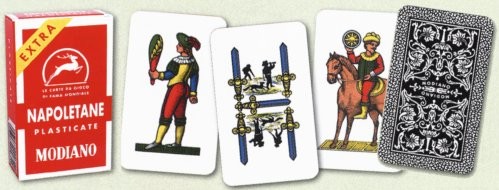
Scopa (Italian Card Game)

The most popular card game in Italy.

There are 40 cards in the deck. Although there are four suits denari (coins), spade (swords), bastoni (clubs), and coppe (cups), cards from various regions of Italy look slightly different.

Generally, each suit contains cards numbered one through seven together with three face cards. The type of face cards also vary from region to region. In the Neapolitan deck, there is a page (fantino), a knight (cavaliere), and a king (re), worth 8, 9, and 10, respectively.

Scopa is played by two players or by four players in teams of two. The two players of a team sit across from each other. Scopa cards are too thick to be shuffled against a table so are instead, shuffled in hand. The team or player to deal the cards first is determined by cutting the deck. The highest card deals first, then the play moves counterclockwise.
  1. Each player is dealt three cards face down and four cards are placed face up in the center of the table.
  2. At each player's turn, he can either pick up a card or cards in the center by matching them to the value of a card from his hand (i.e., three picks up a three, nine picks up a four and five).
  3. When this is done, the player shows the card he is using and removes the played card together with the picked up card or cards to the team pile.
  4. A player cannot use a single card to pick up a multiple of cards if there is a card of equivalent value facing up.
  5. If a player is unable to pick up any cards, he must add a card from his hand face up to the center of the table.
  6. Once no one has any more cards in their hands, the dealer deals three more cards to each player and play resumes.
  7. If there are any cards on the table after the last card of the last hand, the team or player that picked up the last card gets the remaining cards.
Points are counted after the last cards are played, as follows:
  • One point for the team or player with 21 or more cards.
  • One point for the card known as settebello (the sette di denari - seven of coins).
  • One point for 6 or more denari cards, including the settebello.
  • One point for La settanta. This point is made by obtaining the highest total using four cards, each from a different suit, but face cards are not counted. Four sevens makes the point easily. Three sevens and a six also makes the point.
  • One point for each scopa.
Scopa, which means to sweep, is made by picking up, or sweeping up, the last card or cards on the table so that there are none left.
  • When a player does this, he yells scopa!
  • It's the only point that can be made more than once in a round.
  • The scopa is recorded by keeping the card that made scopa face up in the team pile.
  • The last play of the last hand is not counted as a scopa.
The game continues until one team or player reaches 11 or 15 points, the winning score to be agreed upon between the players prior to the start of the game.

Reprinted from Dante Alighieri Society of Washington's flyer, THE RULES OF SCOPA.

Armi-Capitolo II (Weapons-Chapter 2)

Red Devil

Hand Grenades:

Beyond pistols and rifles, partisans certainly made use of other forms of weaponry as mission needs dictated. When participating in Allied battlefield activity, individual fighters might be equipped with hand grenades for use against enemy formations and hard targets. Available grenades included:
  • Italy: M35 Red Devil. This is a series of three different looking hand grenades made by three different manufacturers.  They are 'offensive' type having thin sheet metal construction (mostly aluminum) and no other shrapnel. Painted a vivid red and having a notorious reputation of being dangerous when found in an unexploded condition, they were nicknamed Red Devils by the British during the North African campaigns. Cast resin replicas of the Breda M35 can be found on ebay though I cannot imagine they are very useful beyond the collection shelf.
  • Germany: M24, M43 potato masher stick grenades. The potato masher is perhaps the most recognizable piece of WWII ordinance. Like the Red Devil, it is an 'offensive' type of grenade, however the Germans made an optional slip on shrapnel cover to convert it to a fragmentation grenade. Several sources make replicas, though they are usually a bit pricey.
  • UK: Mills Bomb. This is perhaps the first successful fragmentation grenade. It looks a lot like the American pineapple but is a bit squat. Resin reproductions exist.
  • US: Mk 2 pineapple. This familiar fragmentation hand grenade has changed little over the years, though experts can distinguish between the various vintages. Inert metal replicas are cheap and widely available, but shouldn't be used at reenactments because of the danger of hitting someone - they're quite heavy! Somewhat pricey resin reproductions are available.

Submachine Guns:

MAB 38
We've already noted that Partigiani made use of whatever weapons they could get their hands on. By the time the action moved into northern Italy, they had a lot of submachine guns. Some were acquired locally (Italian and German) and others had been air-dropped by the British and Americans.

As you know, one cannot own a fully automatic firearm without the appropriate license from the BATF. Most reenactors who want to use such a firearm resort to purpose-built units that are configured to never be able to fire a projectile. Still, blank-firing replica is an expensive choice; such firearms typically sell for close to $2,000.
  • Italy: Beretta MAB 38. An interesting feature of this SMG is its two triggers: one for full-auto firing and one for single shots. Like its contemporaries, the German MPs and the British Stens, it fired the 9x19 mm parabellum pistol cartridge. The next time you have a spare $2,300 on hand, you can exchange it for the blank-firing version of one of these.
  • Germany: MP38, MP40. Wrongly called Schmeisser because of it's apparent descendency from the WWI-era MP18 designed by Hugo Schmeisser. This and the Thompson are likely the most common SMGs at any WWII living history event.
  • UK: Sten Mk II. Dropped in their hundreds to the partisans, the Sten was quite popular, particularly among the militarized groups in the north. A blank-firing replica can be had for as little as $1,600.
  • US: Thompson SMG. The Tommy Gun is one of the most recognizable guns in the world and an icon of American firearm production. I'm not sure what it might cost to own one of these.

Inni Partigiani I (Partisan Hymns 1)


Bella, Ciao! (Goodbye, Beautiful)

This song was supposedly sung by Partigiani between 1943 and 1945, however it is unknown when the song first appeared. The author of the lyrics is unknown; the music derives from a folk song sung by rice field workers in the River Po basin in the early part of the 20th century.

Because of this regional connection and the clandestine nature of the Italian Resistance around Rome, it's likely that Bella, Ciao! did not come into widespread use until the formation of the militarized partisan organizations in northern Italy. Note too, that there are many slight variations in the rendition of the lyrics.
Questa mattina, mi son svegliato,
O bella, ciao! bella, ciao! bella, ciao, ciao, ciao!
Stammattina, mi son svegliato,
E ho trovato l'invasor.

O partigiano, portami via,
O bella, ciao! bella, ciao! bella, ciao, ciao, ciao!
Partigiano, portami via,
Ché mi sento di morir.

E se io muoio, da partigiano,
O bella, ciao! bella, ciao! bella, ciao, ciao, ciao!
Se io muoio, da partigiano,
Tu mi devi seppellir.

E seppellire, lassù in montagna,
O bella, ciao! bella, ciao! bella, ciao, ciao, ciao!
Seppellire, lassù in montagna,
Sotto l'ombra d’un bel fior.

Tutte le genti, che passeranno,
O bella, ciao! bella, ciao! bella, ciao, ciao, ciao!
Tutt’le genti, che passeranno,
Mi diranno «Che bel fior!»

«È questo il fiore, del partigiano»,
O bella, ciao! bella, ciao! bella, ciao, ciao, ciao!
«È quest’il fiore, del partigiano,
Morto per la libertà!»

The gist of the lyrics, by verse, is:
  1. This morning I awoke and found the invader.
  2. Partisan, take me with you, for I feel like I'm about to die.
  3. And if I die as a Partisan, you must bury me.
  4. Bury me up in the mountains, in the shadow of a beautiful flower.
  5. And the people passing by will say to me, "What a beautiful flower!
  6. This is the flower of the Partisan, who died for liberty.