Months have passed since my last post. Partially to blame is my distractibility. But it's also an issue of it becoming more difficult to find new things about which to write. That's not to say that I have plumbed the depths of research and have at last come up empty; oh, far from it!
Gli Americani e la Guerra di Liberazione in Italia (The Americans and the War of Liberation in Italy)
This esoteric volume contains the proceedings of a conference held in Italy in 1994 on the American interaction with the partisans. Each conference presentation is included in both Italian and English; a fact that I realized only after having read about half way through the Italian language section).
Much of the content discusses the various OSS (Office of Strategic Services) "Missions" and their roles in several operations, principally in northern Italy after the liberation of Rome. While possibly of interest to the hard-core WWII historian, this small (and often expensive) volume contains little of practical use for the typical partisan reenactor.
World War II Partisan Warfare in Italy
On the other hand, this Osprey 'Elite' series publication should prove quite useful to the aspiring partisan reenactor. Chapters in the book include:
- From early resistance to partisan warfare
- Partisan warfare
- Insurgency: Summer 1944
- Crisis: Autumn-Winter 1944
- Recovery: Spring 1945
- Summary:
- The partisans
- The German reaction
Authors Pier Paolo Battistelli and Piero Crociani present a thoughtful and balanced account of the partisan experience and that of their foes in the struggle to liberate the country. Fifteen color illustrations of selected combatants as well as many period photographs are sprinkled throughout the book. All in all, if you buy but one book to guide you in creating a good partisan impression, let this be it!
Saturday, February 6, 2016
Tuesday, June 24, 2014
La Storia del Podestà (History of the Fascist Town Mayor)
Now that I've completed a replica of this Podestà uniform for the 'town battle' at the upcoming March on Rome event, it seemed appropriate to share what I know about this mayoral officer.
In 1927 the office of mayor (sindaco) was replaced by that of Podestà (magistrate, more or less). The Podestà wielded more power than a mayor as he was also a police official as well as a judge of sorts. Other than that, he was a simple functionary who was expected to act within the law and according to the directives of the national government. I'm fairly certain that Podestà was an appointed office (not elected by the people being governed).
Small communities of less than 5,000 inhabitants were the first to change over to this new municipal system. The rest of the nation soon followed, with the exception of Rome, which retained a unique form of administration headed by a governor. In addition to the Podestà, communities of more than 20,000 inhabitants were assigned a Vice Podestà and communities of more than 100,000 were authorized two.
To be appointed to either office a candidate had to meet two sets of requirements:
Generic:
- Be an Italian citizen with full civil rights.
- Be married or a widower.
- Be of good moral and political character.
- Be of Aryan descent (after 6 Oct 1938).
The diploma requirement was waived for:
- Veterans of WWI who had held the rank of Ufficiale or Sottufficiale commanding troops in a zone of occupation.
- Other functionaries who had served at least six months as mayor, royal or prefect commissioner, or community secretary.
Monday, June 16, 2014
Nome di Battaglia (Battle Name)
In the autumn of ’43, a Jewish youth fled from Milano with his parents and sister and arrived at Lago d’Orta among partisans led by Filippo Maria Beltrami. The youth, who had just turned 18, introduced himself, “My name is Guido. We are Jewish. We arrived yesterday.” Guido continues: “From this introduction, it is certain, my name da partigiano was derived: Guido l’Ebreo.” At first, he was offended that the partisans would refer to him in much the same way as had the fascists. But before long he discovered that virtually no one among the partisans used his or her real first name, let alone surname, for obvious reasons. The simple act of calling out to one’s buddy during an action, using his real name, would put his family in danger.
The “birth” of a partisan and the leaving behind (for the most part) of community and family, happened via a rite of assimilation into this new world during which the recruit took a new identity; a nome di battaglia. At times imposed, but more often freely chosen, battle names served to seal away one’s real identity and to fulfill specific cultural and symbolic functions. These names often evoked thoughts of a new and fantastic universe where anything might be possible, a remarkable feat for people who had spent 20 years, often their entire life, under the boot of Fascism.
A few interesting statistics regarding the battle names of some 64,000 Piemontese partisans whose nomi di battaglia are known:
- The 13 most popular names were typical Italian given names. The English given name Tom was 14th, Lupo (wolf) 15th, and Fulmine (lightning) came in at 16th.
- Around 25% used their own given name (including diminutives) or a nickname.
- Other names arose from literature, history, popular culture (especially American culture), and from animals.
- Duplicate names were often handled by sequential numeration (Beppe II, Romeo XIV, etc.).
Sunday, June 8, 2014
Vocabolario III (Vocabulary 3)
One of the camerati asked for an audio pronunciation guide for the military vocabulary words that I posted last June...
Enjoy - <<Castoro>>
Enjoy - <<Castoro>>
Saturday, May 24, 2014
Cucina per 6 Ufficiali (Kitchen for six Officers)
Okay. So first off I'll admit that this isn't the likeliest of accessories for a partisan group...but it's just too handy and useful (not to mention period perfect and downright amazing) to let it be. It's a 75 pound, 12"x12"x30" box of aluminum and steel wonderment that provides the cooking and dining gear necessary to keep six Italian officers reasonably well-fed. All that's missing is a heat source and the food itself.
I purchased the kitchen in the photo in early August 2013 and it arrived in time to accompany us to Operation Mountain Victory at Ft. Carson, Colorado. As purchased, the box was sound but in poor cosmetic shape; it had been repainted multiple times and its proper stenciling was long gone. My research, such as it was, suggested that these cases were originally painted a medium brown, so I performed a quick restoration including making the stencil to re-label the face. Note that at some point, many of these sets were repainted green, but the area around the stenciling was left brown so as to not have to redo the lettering.
The contents are nothing short of amazing! There are five cooking vessels plus a coffee pot, containers for coffee, sugar, and salt, a small strainer, cheese grater, and bottles for oil and vinegar (the containers for salt and vinegar are glass lined to stave off corrosion). Add to that a complete set of cooking, cutting, and serving utensils including a corkscrew, old-school can opener, three salt-and-pepper shakers, and a beech cutting board. The place settings consist of six each plates, shallow bowls, coffee cups, drinking cups, knives, forks, and spoons (regular and demitasse), and six egg cups (soft-boiled eggs, anyone?) 85 pieces all told, and not counting the box or the legs!
Legs? Yep! If you empty the contents you'll find four legs that can be slipped into sockets in the four corners of the open box. Lift and flip the box, and voilà! a handy 24"x30" table. Oh, and the large pot - the one with the lid in the photo - has a built-in colander to help you extract the pasta without losing one strand of spaghetti. Had the Italians put this much thought into their armaments things might have turned out markedly different.
While continuing my online cucina research last fall, I came upon another set for sale at Archie McPhee in Seattle. Odd, because I'd been in the store the previous May and seen nothing of the kind (but their photos dated from January). While the exterior was again rough, not a piece (other than the tiny padlock) was missing and many of the pieces were wrapped in their original paper packing. Even better, all of the original flatware, serving spoon and fork, kitchen knives, and can opener were present - these had been replaced with generic pieces by a previous owner of my first set.
Oddly, the six demitasse spoons carry the inscription "E.I." on the back of their handles. This is most certainly the abbreviation for "Esercito Italiano," the official name of the postwar Italian Army. I can only surmise that these sets were retained in the postwar army's inventory and the demitasse spoons must have been added at a later date. Still, I have little doubt that this set existed during the war. The National WWII Museum has a well-provenanced Kitchen for 3 Officers in its collection, suggesting that these were common pieces of gear for the Royal Italian Army.
Deine Papiere, bitte II (Your papers, please 2)
A little over a year ago, in part 1 of this topic, I discussed the importance of being able to substantiate one's identity in wartime Italy. To Americans this is a rather foreign subject as we are not used to carrying identification as a prerequisite for just being out in public. I'm not sure when carrying an ID became mandatory in Europe, but it was definitely required in Italy some years before the war broke out. Everyone over a certain age needed a Regno d'Italia Carta d'Identità (CdI or Kingdom of Italy Identity Card).
Most blue-collar workers and salaried employees belonged to the local Opera Nazionale Dopolavoro (OND or National Recreation Club), the government-sponsored leisure and recreational organization (read more at Wikipedia). The OND provided all sorts of sports, recreational, and cultural events and opportunities; it was a sort of 'YMCA on steroids.' You needed a separate ID for the OND and could purchase a sticker-stamp that would gain you admission to special cinema or live theater events. These IDs were issued annually.
The situation surrounding Fascist Party membership is a bit confusing. According to Wikipedia, in 1939 approximately 6 million of the 44 million Italians were members of the Partito Nazionale Fascista (PNF or National Fascist Party), yet the same article states that "...from 3 June 1938 those who did not join the party could not work." Did children and home-bound women really make up 86% of the population? Either way, following Mussolini's ouster and the establishment of the Repubblica Sociale Italiana (RSI or Italian Social Republic), the PNF was transformed into the Partito Fascista Repubblicano (Republican Fascist Party).
One characteristic all of these IDs had in common was a photograph of the cardholder. We 'moderns' sometimes forget that in days past, societal conventions tended to be much more formal than they are today. Having collected several vintage Italian IDs (and scans of others from ebay auctions), I've noticed that just about every one bears a photo in which the person made every attempt to look his or her best.

For il signore, this means white shirt, necktie, and usually a suit coat or jacket. Hair was combed and tended to be short (though not always) and beards were sometimes worn. La signora (signorina)typically wore a dark, conservative dress or blouse and skirt. Hair was typically worn up and away from the face.
The photograph was usually glued to the ID, sometimes reinforced with small staples in the corners. As a security measure, the photo on a CdI was sometimes attached with embossed rivets (as seen in the lady's portrait) or small metal grommets. After attachment to the CdI, the photo was almost always embossed to the card; another security measure. You can see the embossing in the lower left corner of the signorina's portrait and on the lower right of the signore's.
Wednesday, December 25, 2013
Aspetto Personale: Partigiano Ossolano (Impression: Ossolan Partisan)
In the hectic weeks following the dismissal of il Duce and the flight behind Allied lines of King Victor Emmanuel and Marshal Badoglio (Mussolini's successor), the partisans in several northern valleys proclaimed independent antifascist republics, expelled German and Fascist troops from within their boundaries, and set up local governments.
These partisan republics only lasted for a few days to two months at best. One of the more notable was the Repubblica dell'Ossola, centered around Domodossola in the valleys south of the Simplon Pass. Again, this assortment of clothing and gear is representative of what might have been worn. Interestingly, the Ossolani were well organized and even devised a somewhat unique official uniform of their own (more on this later). The items shown in the picture include:
1. Moschetto Automatico Beretta 38/44 - Beretta 38/44 SMG
2. Fondina e pistol Beretta 34 - Holster and Beretta 34 pistol
3. Mostrine rosse con stelle alpine - Red collar insignia with edelweiss pins
4. Giacca del R.E. - Italian army jacket
5. Granate a mano - Hand grenades )German)
6. Cinta - Belt
7. Camicia inglese - British shirt
8. Copricapo Alpino - Alpino hat
9. Sottovestiti di lana - Wool underwear
10. Scarponi - Boots
11. Calzini di lana - Wool socks
12. Fazzoletto rosso - Red neckerchief
13. Pantaloni mimetici - Camouflage trousers
14. Sigarette - Cigarettes (American)
15. Giberne - Ammo pouches
Italians were among the first adopters of printed fabric camouflage, known as Telo Mimetico. These trousers were likely of German origin but made using camo cloth appropriated from Italian warehouses.
Some sources describe the partisans of northwestern Italy as being largely non-communist, however the red neckerchief suggests otherwise.
Sunday, December 22, 2013
Aspetto Personale: Brigate Garibaldi (Impression: Garibaldi Brigades)
Brigate Garibaldi were organized primarily by the Italian Communist Party and for the most part were populated by communists, socialists, and anarchists. Garibaldi was a central figure in the formation of a unified Italy during the middle of the Nineteenth century. To some extent, this partisan force descends from the Garibaldi Brigades that the communists sent to Spain to fight along side their Spanish comrades during the war against Franco's forces in the 1930s.
Again, this is just a plausible sample of how a Garibaldino might be outfitted. Much of the partisan's clothing and gear consists of items collected on the battlefield or received from the OSS or SOE.
1. Beretto R.E. con stella rossa - Italian army hat with red star
1a. Colbaco con stella rossa - Winter hat with red star
2. Fazzoletto rosso - Red neckerchief (color usually indicates communist partisan)
3. Giacca Militare - Military style jacket
4. Pistola Walther P38 - Walther P38 9mm pistol (German)
5. Fondina - Holster
6. Mitra Thompson - Thompson submachine gun
7. Stivali - Boots
8. Calzini - Socks
9. Pantaloni X Mas, preda di guerra - Captured X Mas trousers
10. Maglione a colo alto - Turtleneck sweater
11. Giberne - Ammo pouches
12. Pipa e tabacco - Pipe and tobacco
13. Borraccia e gavetta - Canteen and cup (German)
14. Gradi di Commandante di Divisione - Insignia of a Division Commander
15. Cinta - Belt
16. Coltello pieghevole - Folding pocket knife
Sunday, November 24, 2013
Aspetto Personale: Brigata Osoppo (Impression: Osoppo Brigade)
The Osoppo Brigades were anticommunist partigiani originating in the province of Friuli in the northeastern part of the country bordering on Austria.
The clothing in this example should not be construed as being any sort of uniform; it's still just a case of wearing what one has on hand.
1: Basco nero con insegno tricolore - Black beret with tricolor patch
2: Fazzoletto verde - Green scarf
3: Maglione - Pullover sweater
4: Giacca di pelle - Leather jacket
5: Pantaloni tedeschi - German trousers
6: SMG Sten
7: Scarponi e calzini - Boots and socks
8: Giberne - Ammo pouch
9: Binocolo - Binoculars
10: Gavetta tedesca - German mess kit
11: Granate a mano - German hand grenades
12: Bretelle - Suspenders
13: Baionetta - Bayonet
14: Orologio da taschino - Pocket watch
15: Bussola RAF - Compass
The Sten gun (#6) was air dropped in large numbers to various partisan groups between 1943 and 1945. German items (trousers, mess kit, "potato masher" grenades, etc.) were battlefield pick-ups.
Saturday, November 23, 2013
Aspetto Personale: Gappista (Impression: G.A.P. Operative)
Here is the first of four informative plates describing typical partisan clothing and gear. This outfit would be right for a Roman citizen carrying out clandestine partisan missions in the city. The overcoat (#4) is right for winter and would not look entirely out of place during occasional spring and fall rain showers; otherwise, it would likely be replaced by a suit jacket or work coat.1: Cappello floscio - Hat
2: Orologio da polso - Wrist watch
3: Camicia - Shirt
4: Impermiabile - Overcoat
5: Pantaloni - Trousers
6: Pistola automatica - Semiautomatic pistol
7: Scarpe drop - Low quarter shoes
8: Cravatta - Necktie
9: Tabacco da masticare - Chewing tobacco
10: Documenti falsi - Forged identity card
11: Tirapugni - Brass knuckles
12: Caramelle per la gola - Throat lozenges
13: Penna stilografica - Fountain pen
14: Cinta - Belt
15: Calzini - Socks
16: Fazzoletto da taschino e sigarette - Pocket handkerchief and cigarettes
17: Fascia C.T.L.N. - C.T.L.N. Arm band
18: Soldi - Money
19: Distintivo partigiano - Partisan lapel pin
The pistol (#6) is an Italian-made Glisenti Model 1910, possibly a 'bring home' from WWI. Obviously, other makes of pistol are just as valid. The arm band (#17) and lapel pin (#19) are not for ordinary wear; the parigiano would carry them only when it seemed that a general insurrection might break out (when partisans would self-identify to the citizenry so as to be seen as competent leaders of the revolt).
Friday, September 20, 2013
Biblioteca Partigiana (Partisan Bookshelf)
Most everyone who chooses to get involved in this 'Living History business' eventually finds him- or herself with one or more books in hand, reading up on the selected period, locations, and events pertaining to the history being relived. I am no exception, in fact, my interest in studying history has increased exponentially since I first set out to assemble an accurate U.S.-Mexican War uniform. Reenacting the role of a partigiano italiano has been no different.
The story of the 1943-1945 war in Italy is reasonably well documented but was never as well publicized in the States as, say, the Normandy invasion or the Battle of the Bulge. The average American knows something about the destruction of the abbey at Monte Cassino and recognizes the place name "Anzio," but not much else. Likewise, Americans are quite familiar with the image of the French Resistance fighter but most are totally unaware of the Italian Partisans and their accomplishments in freeing their country from Fascist tyranny.
I started out reading whatever I could find about partigiani italiani and eventually graduated to reading books about the war in Italy. In retrospect, I probably should have done just the opposite; studying the 'big picture' first would have given me a better frame of reference from which to view and ultimately to understand the partisan story. I suppose I'll have to re-read some of those earlier books. Here then is a list of books that I've found useful grouped by subject and scope in a somewhat chronological order:
The War in the Mediterranean Theater of Operations (MTO)
The Italian Navy in World War II by Commander Marc`Antonio Bragadin provides good background material on Italy's view of itself as the deserving dominant power in the Mediterranean (though it held that position for little if any time). Somewhat dry, this book follows a mostly chronological path through the various campaigns from Ethiopia to the 1943 armistice and beyond. This is a difficult (and from what I've seen on ebay, expensive) book to find - mine came from the UNM ROTC library via a discard book sale.
The War in Italy
The Italian Campaign 1943-1945 by G. A. Shepperd is a chronological account of the action from a former British colonel. His treatment of the material is reasonably neutral though he does give the reader some indication of his favorite and less favorite personages on the Allied side. Each chapter begins with a chronological list of pertinent wartime events that occurred in the period being covered, a feature which causes the reader to consider how happenings in other theaters and back home influenced or were influenced by the action in Italy.
From the fall of Mussolini to the Liberation of Rome
The Race for Rome by Dan Kurzman does an admirable job of recounting the alliances, activities, and actions of the significant players involved in the pacification, occupation, and liberation of Rome from the late summer of 1943 until the Allies entered the Eternal City in June 1944. The author does an admirable job of detailing the activities of both sides, deals with the actions and influence of Pope Pius II, and spends a good 30 pages familiarizing us with the Roman partisans, who were still very much underground at this time.
The Battle for Rome by Robert Katz is another account of the events leading up to the liberation of Rome but with a slightly different approach. Here, Rome is a theater stage and the various organizations and people in Rome are the actors. Where appropriate, outside influences are allowed to be felt, but this is mainly the story about how those who were attached to the city, be they soldiers, diplomats, clerics, or partisans played out their roles in the subjugation and eventual liberation of the citizens.
A Spy in Rome by Peter Tompkins is a first hand account of his time in Italy, and more specifically Rome, as an agent of the U.S. Office of Strategic Services. He pulls no punches in expressing his disdain for some of his colleagues, superiors, and even the Allied brass. Along the way, he tells an exciting, sometimes scary, and perhaps slightly embellished story of his activities, including several close calls and near misses. Ultimately, he faults both the Allies for not moving quicker and with more audacity and the Badoglio government for not issuing explicit orders to resist to the Italian High Command, thereby bungling the chance to bring a quicker end to the German occupation of the country.
Italy Betrayed by Peter Tompkins is the story of Fascists and Italian industrialists taking the Italian people to war, their mostly successful efforts to save their skins and their fortunes through an ill-timed armistice, and the Allied failure to take full military advantage of Mussolini's fall. Tompkins provides full details of the conspiracies that led to il Duce's ouster and details the decisions and blunders that kept the Allies in a long and costly war. The book's bibliography cites over 300 other works, many unpublished and others in Italian. By the time I finished reading it, I was thoroughly disgusted with shrewd Fascists, barbarous Nazis, and naïve and sometimes incompetent and egotistical Allied commanders and leaders.
From the Liberation of Rome to War's End
The Outlaws by Luigi Meneghello (translated from the original Italian text i piccoli maestri) is a first person account of a young man who, along with his school buddies, goes from student, to soldier, to partisan in the space of a few short months. The author wrote as if keeping a diary and without the benefit of the hindsight that typically colors the retelling of a true story. As a result, the reader is frequently confused or anxious, as was the author, when faced with the dangers of the day-to-day life of a partisan in northern Italy.
Sunday, September 15, 2013
Radio Roma Libera II (Radio Free Rome 2)
The radio station was a success beyond all expectations and it was extremely gratifying to walk through the 'barracks' and hear the programming playing from individual radio sets in the various rooms. There was but one malfunction - for reasons unknown, one afternoon Windows Media Player failed to move on to the next mp3 file. Fortunately, I was in the vicinity and so was able to launch the file manually with only a brief delay.
I cannot say enough about Media Outlet's Old Time Radio World War II MegaSet which was the source for nearly all of the material for the broadcasts. While one might bristle at paying for old radio programs that are in the Public Domain (and not too difficult to find online), your time is worth much more than Media Outlet's $14.49 price. Many of the mp3s include information about the "air date" of the program (usually embedded in the file name). Be advised that there is some post-war material included on the DVDs, but it's easily recognizable by checking the date.
The Media Outlet discs contain mostly Allied material, but there are a few hours of German programming as well. Unfortunately, for the MTO (Mediterranean Theater of Operations) there is very little Italian language material, outside of a few Italian songs and a couple of Mussolini's speeches. For this, I turned to the Italian State Radio and Television system, or RAI. With an online translator, a bit of trial and error, and some appropriate audio recording software, you can glean useful material from the RAI History site.
If you're interested in having your own low-power AM radio set, so as to become the next Edward R. Murrow, send me a message (preferably not in Morse Code)!
Saturday, August 3, 2013
Radio Roma Libera I (Radio Free Rome 1)
With the next few postings, I'm wandering a ways off of the 'Partigiano' thread to discuss my experiences setting up and operating a radio station to broadcast period programming during "March on Rome," a Mediterranean Theater of Operations WWII reenactment held at Ft. Stanton, NM during the last weekend in July.
My plan for MoR IV was to set up a low-power AM radio station to broadcast WWII era music, radio variety shows, and news programs during the event. All the participant "listeners" would have to do is bring an AM radio with them. Thankfully, this effort succeeded beyond my expectations.
The basis for the station is a low-power, no license transmitter called the "Talking House" (TH). This device is used by real estate agents to broadcast info about a house for sale to potential buyers sitting in their vehicle in front of the property. But the TH can be used for any legal purpose; it's not just for real estate sales.
The TH has internal storage for five minutes worth of audio, however it also has a 'line in' jack that allows it to accept an audio stream whose duration is limited only by the capabilities of the source device. For my station, I connected the TH input to the headphone jack of a laptop computer. The mp3 audio files came from a massive assortment of 1940s programming I purchased from an internet vendor - the performances are all considered to be in the public domain.
To impart maximum realism to the programming, I recorded voice 'time hacks', station identification (Armed Forces Radio Service, or A.F.R.S.), sign ons and sign offs, and a verbal statement explaining why occasional Nazi and Fascist material was being broadcast. Then, using audio editing software, I assembled the material into hour long blocks that opened with a time hack and station identification and saved each as a single mp3 file. The opening of the first hour's broadcast included the playing of reveille and the closing broadcast of each day included the playing of the National Anthem.
All that remained was to create a Playlist in Windows Media Player for each day and to place the appropriate mp3 files into each. From here it was a simple matter to start up the computer each day at the appointed time, launch Media Player, and double click the day's playlist...instant, and unattended radio programming. To get the word out, I printed daily program schedules to post in various locations around the camp. For a Forties feel, I printed the schedules on original, watermarked 'onion-skin' typing paper using a vintage looking typewriter font. Taking it a step further, only the first copy of each day's schedule was in black text, the other four copies were printed in a purple that to me made it look like carbon paper copies.
Axis music and propaganda programs were included three or four times a day using the subterfuge of signal drift; the scheduled program would drift off into the world of static and a German or Italian program would take it's place. Sometime before the end of the hour, the inattentive station engineer would notice the problem and quickly retune the equipment back to the A.F.R.S. program feed. To communicate this to listeners, the printed schedule was annotated during specific hours, explaining that 'atmospheric conditions' might permit competing programming from Axis transmitters to horn in on the A.F.R.S. frequency.
Tuesday, July 9, 2013
Inni Partigiani III (Partisan Hymns 3)
Nothing earth-shaking to report, however I stumbled upon a nice and somewhat touching video on YouTube that captures the singing of "Bella, Ciao!" by a group of vecchi ('oldsters'), many of whom were likely real partigiani back in the day.
'Nuff said (for now)!
Saturday, June 29, 2013
Vocabolario II (Vocabulary 2)
Useful Phrases:
- Help me. I am lost. - Aiutami. Sono sperduto.
- Draw me a map. - Fatemi uno schizzo.
- Are there soldiers near here? - Ci sono dei soldati vicini?
- I am wounded. Get a doctor. - Sono ferito. Chiamate un dottore.
- Where is the enemy? - Dov'è il nemico?
Orders and Warnings:
- Look out! - Attenzione!
- Take cover! - Mettetevi a riparo!
- Quiet! - Silenzio!
- Stand up! - Alzatevi!
- Come forward! - Venite avanti!
- Turn around! - Voltatevi!
- Stop! - Fermatevi!
- Who goes there? - Chi va là?
- Identify yourself! - Fatevi riconoscere!
- (Give the) Sign! - Parola d'ordine!
- Countersign! - Contraparola d'ordine!
- Don't move! - Non muovetevi!
- Surrender! - Arrendetevi!
- Throw down your weapons! - Buttate a terra le armi!
- Hands up! - Mani in alto!
- Line up! - Mettetevi in fila!
- Don't try anything! - Niente trucchi!
- Obey or I'll fire! - Ubbidite o sparo!
There! That should get you through!
Wednesday, June 26, 2013
Omonimi delle Battaglie MoR I (MoR Battle Namesakes 1)
CAMPO DI CARNE
Campo di Carne is a small town on the road between the Anzio beachhead and Aprilia, south of Rome. Its existence can be established as far back as 1661 when it was included on a colorful map of the area. The origins of the name (literally, 'field of meat') are presumed to be rooted in the long-standing use of the area as a place to raise cattle and other animals for eventual human consumption. By mere coincidence, the town's peculiar name would take on additional significance during World War II.
By January 24, 1944, the Allied Forces that had come ashore at Anzio-Nettuno had reached Campo di Carne while German units were massing north of Campoleone. Territorial gains beyond Carroceto and 'The Factory' (Aprilia) extended the line, until the ferocity of Operation Fischfang (=Fishery) forced British 56th Division to retreat to Dead End Road, close to the overpass (a road bridge over the railway) at Campo di Carne from where they had set out three weeks earlier.
The overpass, known as 'The Flyover', was under severe and constant bombardment from heavy artillery in the Alban Hills and was known to men who had to fight there as 'The Gate to Hell'. The nearby railway station still exists but there is no immediate sign of the carnage that took place in 1944. War photographs of the overpass have come to represent the horror of the Anzio beachhead. By most accounts some 30,000 people, civilians included, died during the fighting in this area.
Monday, June 17, 2013
Varie Cose I (Odds and Ends part 1)
La Borsa Tactica (The Tactical Case)
This little 10"x10"x5" oddity has been the source of a lot of confusion and discussion. An Italian surplus dealer described it as a pre-war satchel charge container; someone else said it was a clerk's desk; others insisted that it's a post-war item, but could not say for sure what it was. Given that it's made of tin covered with canvas, I sort of felt that it had some purpose where it would be handy, if not indispensable, to protect whatever was inside from contact with hot stuff falling from the sky. I acquired one online for less than $20; someone sold one in Australia for over $90 and I've seen them for as little as $10.Turns out it's a Borsa per accessori da mina (Case for demolitions materials), the argument concluded thanks to a printed inventory sheet found inside one example. The items that were normally carried inside include:
- n.1 coltello da tasca
- n.1 forbicetta mezzana
- n.1 pinza tagliastrozza
- n.1 gomitolo di spago da mm.2 straforzinato
- n.1 gomitolo di spago da mm.0,6
- n.50 tubetti di gomma per giunzione miccia
- n.1 martello a granchio
- Kg. 0,5 punte di filo ferro
- Kg.05 cambrette
- n.1 rotolo nastro isolante
- n.10 clips per giunzone miccia
- n.1 tasca per tritolo vuota
- n.1 borsetta per miccia vuota
Torcia Rettangolare (Square Flashlight)
I'd never seen one of these before March on Rome III in 2012. They were evidently common (standard issue?) among German soldiers and examples made in other European countries can be found. A major Italian producer of similar units was Vigila Pagani, though some say that they didn't get into making this sort of flashlight until after the war.The unit typically has one or more colored filters that can be lifted into position via the appropriate slider and leather or vinyl tabs with button holes at the top and bottom for fastening it to shirt or tunic buttons for hands-free operation. These are typically powered by an odd (to Americans) 4.5V rectangular battery that costs $6 to $9 and has to be special ordered.
I've found a source for replacement battery boxes that hold 3 AA batteries. To this, I added a stick-on wrapper laboriously copied from a vintage Italian Superpila battery. I also have artwork for a Wehrmacht-issue Daimon-brand battery.
Wednesday, May 29, 2013
Inni Partigiani II (Partisan Hymns 2)
Fischia il Vento (The Wind Whistles)
According to Wikipedia, "Fischia il Vento is an Italian popular song whose text was written in September 1943, at the inception of the resistenza. The lyricist was Felice Cascione and the intention was to spur on the partisan movement. The music is that of the Russian popular song Katyusha.Along with Bella, Ciao! it is one of the most famous songs celebrating the resistance."
Fischia il vento e infuria la bufera,
Scarpe rotte e pur bisogna andar
A conquistare la rossa primavera
Dove sorge il sol dell'avvenir.
A conquistare la rossa primavera
Dove sorge il sol dell'avvenir.
Ogni contrada è patria del ribelle,
Ogni donna a lui dona un sospir,
Nella notte lo guidano le stele
Forte il cuore e il braccio nel colpir.
Nella notte lo guidano le stele
Forte il cuore e il braccio nel colpir.
Se ci coglie la crudele morte,
Dura vendetta farà dal partigian;
Ormai sicura è la dura sorte
Del fascista vile traditor.
Ormai sicura è la dura sorte
Del fascista vile traditor.
Cessa il vento, calma è la bufera,
Torn'a casa il fiero partigian,
Sventolando la rossa sua bandiera;
Vittoriosi e alfin liberi siam.
Sventolando la rossa sua bandiera;
Vittoriosi e alfin liberi siam.
Click the Wikipedia link at the top of this post for a translation of the lyrics.
At YouTube, search on 'canti partigiani' to find tons of video and audio files.
Sunday, May 26, 2013
Scopa (Italian Card Game)
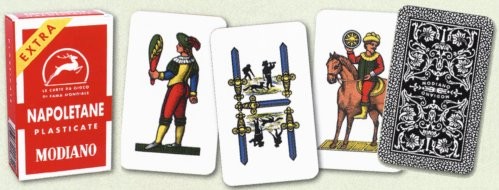
The most popular card game in Italy.
There are 40 cards in the deck. Although there are four suits denari (coins), spade (swords), bastoni (clubs), and coppe (cups), cards from various regions of Italy look slightly different.Generally, each suit contains cards numbered one through seven together with three face cards. The type of face cards also vary from region to region. In the Neapolitan deck, there is a page (fantino), a knight (cavaliere), and a king (re), worth 8, 9, and 10, respectively.
Scopa is played by two players or by four players in teams of two. The two players of a team sit across from each other. Scopa cards are too thick to be shuffled against a table so are instead, shuffled in hand. The team or player to deal the cards first is determined by cutting the deck. The highest card deals first, then the play moves counterclockwise.
- Each player is dealt three cards face down and four cards are placed face up in the center of the table.
- At each player's turn, he can either pick up a card or cards in the center by matching them to the value of a card from his hand (i.e., three picks up a three, nine picks up a four and five).
- When this is done, the player shows the card he is using and removes the played card together with the picked up card or cards to the team pile.
- A player cannot use a single card to pick up a multiple of cards if there is a card of equivalent value facing up.
- If a player is unable to pick up any cards, he must add a card from his hand face up to the center of the table.
- Once no one has any more cards in their hands, the dealer deals three more cards to each player and play resumes.
- If there are any cards on the table after the last card of the last hand, the team or player that picked up the last card gets the remaining cards.
Points are counted after the last cards are played, as follows:
- One point for the team or player with 21 or more cards.
- One point for the card known as settebello (the sette di denari - seven of coins).
- One point for 6 or more denari cards, including the settebello.
- One point for La settanta. This point is made by obtaining the highest total using four cards, each from a different suit, but face cards are not counted. Four sevens makes the point easily. Three sevens and a six also makes the point.
- One point for each scopa.
- When a player does this, he yells scopa!
- It's the only point that can be made more than once in a round.
- The scopa is recorded by keeping the card that made scopa face up in the team pile.
- The last play of the last hand is not counted as a scopa.
Reprinted from Dante Alighieri Society of Washington's flyer, THE RULES OF SCOPA.
Armi-Capitolo II (Weapons-Chapter 2)
![]() |
| Red Devil |
Hand Grenades:
Beyond pistols and rifles, partisans certainly made use of other forms of weaponry as mission needs dictated. When participating in Allied battlefield activity, individual fighters might be equipped with hand grenades for use against enemy formations and hard targets. Available grenades included:
- Italy: M35 Red Devil. This is a series of three different looking hand grenades made by three different manufacturers. They are 'offensive' type having thin sheet metal construction (mostly aluminum) and no other shrapnel. Painted a vivid red and having a notorious reputation of being dangerous when found in an unexploded condition, they were nicknamed Red Devils by the British during the North African campaigns. Cast resin replicas of the Breda M35 can be found on ebay though I cannot imagine they are very useful beyond the collection shelf.
- Germany: M24, M43 potato masher stick grenades. The potato masher is perhaps the most recognizable piece of WWII ordinance. Like the Red Devil, it is an 'offensive' type of grenade, however the Germans made an optional slip on shrapnel cover to convert it to a fragmentation grenade. Several sources make replicas, though they are usually a bit pricey.
- UK: Mills Bomb. This is perhaps the first successful fragmentation grenade. It looks a lot like the American pineapple but is a bit squat. Resin reproductions exist.
- US: Mk 2 pineapple. This familiar fragmentation hand grenade has changed little over the years, though experts can distinguish between the various vintages. Inert metal replicas are cheap and widely available, but shouldn't be used at reenactments because of the danger of hitting someone - they're quite heavy! Somewhat pricey resin reproductions are available.
Submachine Guns:
![]() |
| MAB 38 |
As you know, one cannot own a fully automatic firearm without the appropriate license from the BATF. Most reenactors who want to use such a firearm resort to purpose-built units that are configured to never be able to fire a projectile. Still, blank-firing replica is an expensive choice; such firearms typically sell for close to $2,000.
- Italy: Beretta MAB 38. An interesting feature of this SMG is its two triggers: one for full-auto firing and one for single shots. Like its contemporaries, the German MPs and the British Stens, it fired the 9x19 mm parabellum pistol cartridge. The next time you have a spare $2,300 on hand, you can exchange it for the blank-firing version of one of these.
- Germany: MP38, MP40. Wrongly called Schmeisser because of it's apparent descendency from the WWI-era MP18 designed by Hugo Schmeisser. This and the Thompson are likely the most common SMGs at any WWII living history event.
- UK: Sten Mk II. Dropped in their hundreds to the partisans, the Sten was quite popular, particularly among the militarized groups in the north. A blank-firing replica can be had for as little as $1,600.
- US: Thompson SMG. The Tommy Gun is one of the most recognizable guns in the world and an icon of American firearm production. I'm not sure what it might cost to own one of these.
Subscribe to:
Posts (Atom)